
- Home
- Pool equipment upgrades
Guide 04 / The equipment pad
Quieter, cheaper to run, easier to live with.
Pool Equipment Upgrades Guide
A renovation is the best time to rethink the pad: the pump that moves the water, the filter that cleans it, the heater that warms it and the system that sanitizes it. This guide describes each option in general terms so you can judge a proposal.
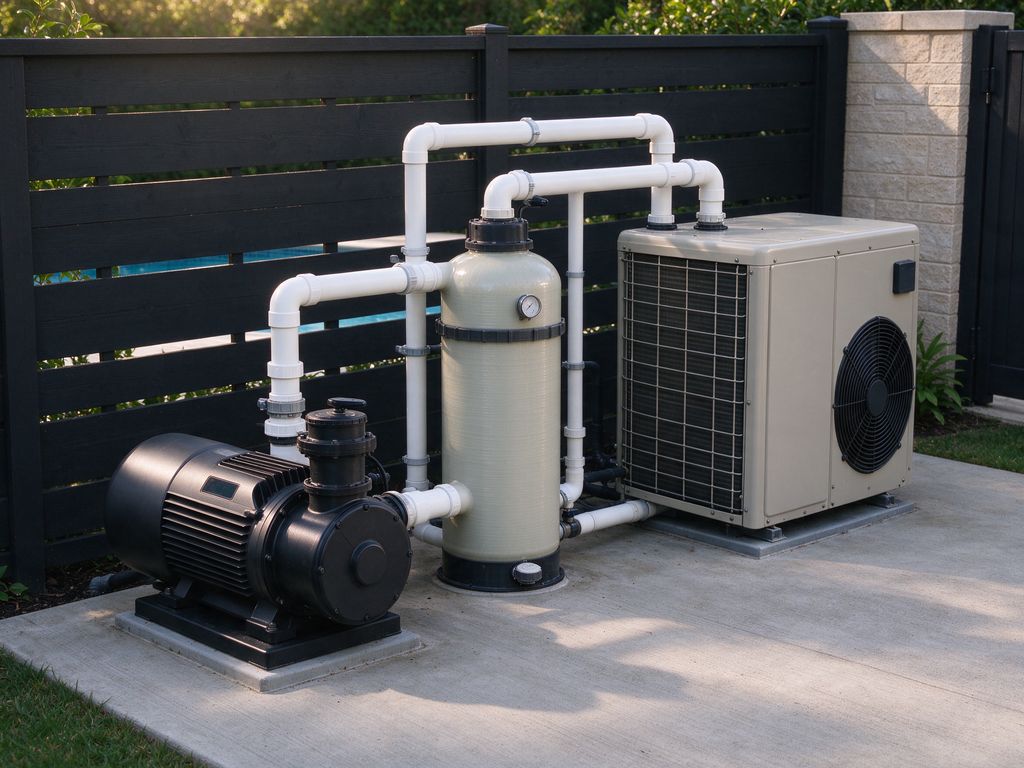
Good equipment is matched equipment. A big pump on a small filter, or a heater starved of flow, wastes money no matter how efficient each box is on paper.
Start With the Plumbing, Not the Brochure
Pool water moves in a loop: out through the skimmers and main drain, through the pump, through the filter, through the heater and any sanitizer, and back through the return fittings. Every elbow and every undersized pipe adds resistance. When contractors talk about sizing, they are matching the pump's flow to the filter's rating, the pool's volume and that resistance. An upgrade proposal should show that the parts were picked together, not one at a time.
Here is a quick way to judge a pad: look at how many valves and bends the water passes through, whether the pipes are the same size coming in and going out, and whether there is room to service each unit. A tidy, well-labeled pad is cheaper to maintain for the next decade.

Row by row
The Pool Equipment Pad, Explained
Hover or tap a row for a plain description of each upgrade.
-
A variable-speed pump runs at the lowest speed that does the job for most of the day and speeds up only for tasks like vacuuming, spa jets or a heater that needs more flow. Because pump power falls steeply as speed drops (the pump affinity laws put it near the cube of speed), long slow runs filter the water with far less electricity than short fast ones.
-
Sand filters are simple and backwashed; cartridge filters skip backwashing and are cleaned by hosing the cartridges; DE filters trap the finest particles and need periodic recharging with filter media. Size matters as much as type: an undersized filter clogs fast and fights the pump.
-
Natural gas or propane heaters warm water quickly regardless of the weather, which suits spas and pools used on short notice. Gas lines, venting and clearances are licensed work governed by local code.
-
A heat pump moves heat from the outdoor air into the water using electricity. It is usually efficient to run in mild weather, heats slowly, and loses capacity as the air gets colder. It needs airflow around it and a dedicated electrical circuit.
-
Salt dissolved in the water passes through an electrolytic cell that converts it to chlorine. The water feels soft to many swimmers and chlorine is produced steadily, but pH tends to drift up, the cell needs inspecting and cleaning, and some natural stone and metals do not tolerate salt well.
-
Controllers schedule pump speeds, heaters, lights and valves from a panel or phone. LED pool lights use far less power than old incandescent fixtures; any light work involves pool-specific electrical safety rules and a licensed electrician.
Variable-Speed Pumps and the Federal Efficiency Rule
The U.S. Department of Energy's efficiency standards for dedicated-purpose pool pumps took effect on July 19, 2021. For most in-ground pools, the practical effect is that replacement filtration pumps above a small size are variable-speed designs. The physics is on the owner's side: running a pump at half speed moves half the water but uses a small fraction of the power, so a long, slow daily cycle can filter the same volume for much less.
The catch is programming. A variable-speed pump installed and left on its highest setting saves very little. Ask the installer to set speeds and schedules for your filter, heater, cleaner and any water features, and to show you how to change them.
Many electric utilities have offered rebates on variable-speed pumps at various times. Programs change, so check your utility's current offers before installation; some require a listed model or proof of programming.
Gas Heater vs Heat Pump vs Solar
| Type | Heats with | Speed | Best fit | Watch for |
|---|---|---|---|---|
| Gas heater | Natural gas or propane | Fast in any weather | Spas, occasional use, cool climates, quick warm-ups | Fuel cost per hour; gas line sizing and venting |
| Heat pump | Electricity moving heat from air | Slow and steady | Season-long heating in mild to warm climates | Output drops in cold air; needs clearance and a dedicated circuit |
| Solar collectors | Sunlight via roof or ground panels | Depends on sun | Extending the swim season where sun is reliable | Roof space, orientation and plumbing runs |
Whatever heats the water, a cover keeps the heat in. Evaporation is a major path for heat loss, so a solar or thermal cover often does more for comfort than a bigger heater.
Salt Chlorine Generators
A salt system is a chlorine pool with a built-in chlorine maker. Salt is added to the water at the level the cell maker specifies, and the cell converts some of it into chlorine as water passes through. Owners like the steady production and softer feel. Plan for these realities:
- pH climbs. Salt pools tend to drift upward in pH and need acid more often.
- Cells wear. The cell builds scale and eventually reaches the end of its life; inspect and clean it as the maker directs.
- Materials matter. Some natural stone coping, metal fixtures and older heaters react poorly to salt. Check compatibility before converting.
- Discharge rules. Some localities restrict where salt water can be drained. Ask before you backwash or drain.
See the pool water chemistry guide for the readings every chlorine pool needs, salt or not.
Questions to Ask an Equipment Installer
- How did you size the pump, filter and heater to this pool and its plumbing?
- Will you program the pump speeds and schedules, and show me how to adjust them?
- Which parts of this job need permits, and who pulls them?
- Is the electrical and gas work done by licensed trades, and will the bonding grid be checked?
- Who registers the manufacturer warranties, and what voids them?
Warranties on equipment often depend on installation by a qualified installer and on registration. Keep model and serial numbers with your pool records. The contractor guide covers what else belongs in the paperwork.
Pool Equipment Questions
Do I have to replace my single-speed pump with a variable-speed pump?
Federal efficiency standards for dedicated-purpose pool pumps took effect in July 2021, and in practice they steer most replacement filtration pumps above a small size toward variable-speed designs. Some states and utilities add their own rules or rebates. Your installer should tell you what applies to your pump size and location.
Is a heat pump or a gas heater better?
It depends on how you swim. Heat pumps are usually cheaper to run in mild air temperatures but heat slowly and lose output when the air turns cold. Gas heaters heat quickly in any weather and suit occasional use or spas, but usually cost more per hour to run. Many owners in warm climates use a heat pump for the season and a gas heater only for quick warm-ups.
Does a salt system mean no chlorine?
No. A salt chlorine generator makes chlorine from dissolved salt in the water. The pool is still a chlorine pool, so you still test free chlorine, pH, alkalinity, calcium and stabilizer.
Do pool equipment upgrades need a permit?
Electrical, gas and some plumbing work commonly requires permits and licensed trades. Requirements vary by city and county, so ask your contractor to confirm and pull them.
Keep reading
Related Pool Guides

Planning a Pad Upgrade?
List the equipment you have now (pump, filter, heater, sanitizer) and what you want to change. Model names from the equipment labels help most.
Request an equipment review